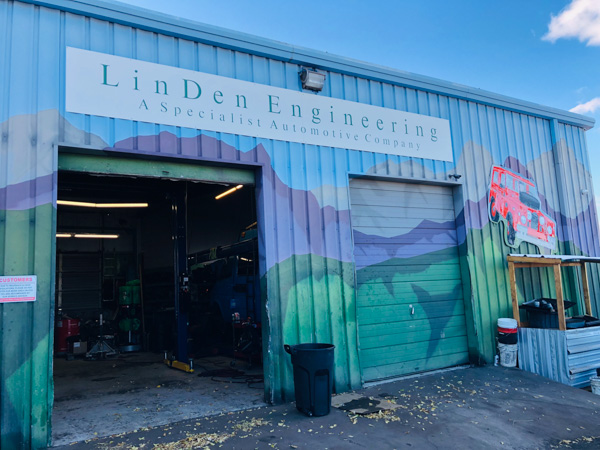
Welcome to Linden Engineering’s APU HQ in Golden Colorado.
We have a specialized shop dealing with the install, maintenance & repair of all types of truck APU’s and other comfort systems like Webasto Blue Cool & combined bunk heater products. Unlike other shops that do truck repairs our facility focuses only on the APU equipment so you get going fast.
In certain cases the operation of the APU is affected by the truck’s engine/chassis interface so we employ mechanics that have intimate knowledge of truck systems; this allows us to identify faults and conditions within the interface of the truck in question and affect a quick repair, so reducing downtime and that saves money.
NOT ALL APU’S ARE CREATED EQUAL.
With the emergence of anti idle laws in California and East Coast states like Vermont, Massachusetts, and NY, so has come the emergence of APU equipment solutions. Just like the truck you own not all APU’s will fit on your truck or give you the desired results you personally need for your types of operation. Sorting through the hype and claims takes a bit of research and we are hoping to give you the tools on this site to find an APU to fit your specific operational and budgetary needs.
INTERFACED OR STAND ALONE.
Basically APU’s differ, inasmuch that some are connected directly to your truck’s heating and cooling systems whereas others are completely separate and operate independently of the truck manufacturers’ comfort systems.
For example the Willis unit is directly plugged in the truck’s engine and heater circuits, so is the A/C. Utilizing the existing comfort systems on the vehicle makes perfect sense, but should trouble arise like a blown head gasket on the truck and a loss of coolant so this will affect the APU and its operation since they are interconnected. This is an important factor when selecting an APU.
The stand alone units are mostly diesel powered generators delivering 115 volts of A/C power. Coupled to a separate 115v air conditioning/heat units such as Dometic is can be encumbered by the space available under the bunk or in the cab to provide adequate heat or cooling. Since it’s “stand alone” big engine pre heat may not be available so you cannot enjoy ease of starting in cold weather as you might do with the interfaced models. Others have shore power accessories and household type fixtures in the cab for microwave appliances etc.
Currently there are about 23 different manufacturers of APU’s for OTR line trucks so choosing the right unit for your truck is essential. A different approach is the Euro truck Webasto Blue Cool system that is totally passive and utilizes stored energy. This unit is CARB compliant for the foreseeable future.
WILL IT FIT?
A good question!
The most common place to install an APU is under the passenger’s door where the tool box or batteries might be currently placed. The other popular spot is the chassis rail aft of the sleeper cab and in front of the forward drive axle. In certain cases due to chassis mounted appendages/equipment the alternative is the driver’s side of the truck although this is frowned upon due to the fact that the driver is exposed to traffic should he need to gain access to the APU for any reason. Sometimes as with a car hauler if there are no viable alternatives it’s really a question of finding any available space!
The next task is to see if there is a clear frame rail space to mount the APU. A Willis APU for example needs around 35 inches or clear rail space. The Temco Idle Solutions unit needs 33.25” for the Tool Box model and 20.25” for the Space Saver variant. The mounts will go 2” minimum dropped off the top of the chassis rail with 5.88 inches of spacing to the lower ¾” grade 8 mount bolts. If space is really tight take a look at Frigette that used to go also under the name of Alliance.
A compact single cylinder generator type unit, the machine is surprisingly reliable but somewhat marred by the “Bop bop bop “ air intake/exhaust racket it makes when running at it’s set run speed.
Since all these units will hang on the frame where say a tool box originally sat makes good sense to utilize existing drilled chassis holes as part of the mount arrangement. I don’t like drilling too many holes in a chassis frame and I never drill a cross member. If you intend to install/purchase a full size unit like a Willis make sure you have plenty of ground clearance. Run a tape measure down from vacant top bolt location to see how much the APU cabinet will clear the ground. Again the Willis needs about 25 inches of drop from the chassis this is very important if you are sizing up a car hauler. I usually sight the front support cross bar to see which would touch down on a speed bump first! Obviously the cross bar needs to touch down not the APU box!
KISS: Keep It Simple
For the simple touch look at Power Technologies who have an ingenious chassis clamp arrangement that makes portability a real option if you intend to trade your rig in the short term but keep the APU for your next truck. The unit is tall and skinny utilizing a two cylinder Kubota or Caterpillar engine. With the frame clamp arrangement the top face of the power cabinet sits higher than the top rail so clearance is never an issue.
A clever idea, and in my opinion American ingenuity at work.
Costs
Since we trade in APU’s we often have good used, recon and NOS floor samples. Our stock changes regularly so call us for what’s going on the cheap. We have no problem with cash and carry U fits and even then we will give you instructions on DIY installs and over the phone help. Some of our APU’s start at $2500 for a used unit in working order need more info just call.
Parts
Alter Blue Cool to $5500
We carry parts for lots of APU’s and will ship to just about anywhere. Again give us call.
(Hablamos Espanol--- Preguntar para Snr Dennis o Snr Julio.
Financing
If you have good credit almost any bank should advance you the funds the buy or lease the unit you select.
We do have recommended in house credit schemes that work with us and the manufacturers. If you have really shaky credit and let’s face it we have all been there at some time (even me) so we do have Buy Here Pay Here (BHPH) plans for most owner operators so no one gets left out.
Part Exchange
Tired of your existing APU? Need to upgrade?
The APU you have is not living up to your expectations?
We are implementing upgrade p/ex programs. Contact us for more details.
APU Service Bulletins. From The APU HQ
August 2009
As a long term Agent/Repairer and Installer of Willis APU’s we have a few service tips to share.
Short A/C compressor life.
This can be broken down into two categories
1) The A/C compressor simply seizes up for no good reason,
2) The compressor clutch goes out and shorts down taking out the micro relay in the ECM and the whole APU plot ceases to work.
Over the years of service support we have noticed that the A/C compressor when started up after a period of say “NO A/C demand” ( like at the end of winter time) creates a huge “crack” sound to resonate from the A/C compressor. This “slugging” as it’s called in the A/C repair business is oil and liquid refrigerant being compressed by the pistons in the compressor.
That shock pressure rise puts huge loads above design parameters and shortens the unit life enormously. The first signs of troubles are oil deposit at the back of the compressor blown out of the HP RELIEF VALVE, and in some cases we have even seen the valve blown out of the back case altogether with a loss of ALL the refrigerant in the truck and the threads in the alloy casting!
Bummer!
So you may ask how does oil get in there in the first place?
Well to be brief, the compressor needs lubrication, so oil is automatically mixed with the refrigerant and it flows around with it within the system when operational. When left unused for a period of time the oil tends to collect in the lower parts of the system—Yes, you got it! The compressor on the Willis APU!
Now this is not a new problem, Ford Motor Company experienced this problem with their Taurus range of cars years ago when the A/C compressor was located low down on the block. They, FoMoCo introduced an “anti-slugging feature” into the car’s A/C control which pulsed the compressor clutch during cranking; so even when there was no need for A/C demand the compressor was slowly rotated to clear the cylinders of oil without damaging the reed valves and pistons. Clever eh?
You could say another bit of American ingenuity! This was repeated many times over & in fact on every start up cycle irrespective of whether or not A/C was selected, the compressor cylinders were purged of oil.
Taking that concept we have introduced recently an ANTI-SLUGGING FEATURE FOR THE WIILLIS APU. The conversion is very simple to introduce and we will have DIY kits available shortly. This will extend the lifetime of your compressor and operating system Please contact us for details if you need kits or info to self convert.:- dennis@lindenengineering.com
ALSO SEE PART 2 OF THIS BULLETIN.
Electrical Loads.
In order to protect your Willis APU A/C electrical system a fused link assembly was introduced at the truck compressor interface during 2008 and at the APU A/C compressor within the cabinet. Look to see if your truck is so equipped.
Electrical overloads seem to be more prevalent on Kenworth/Willis converted units (but not solely affected) and sadly when an APU A/C compressor clutch shorts out the load is transferred to the micro relay soldered into the controller circuit board and this fries the circuit and controller shutting down the APU rendering it useless. So., if you suspect this; remove the cover on the controller (ECM) and look for burning and that tell tale smell of burnt electrics. The unit costs about $800 to replace, so it’s important to protect the system to avoid this costly failure.
Combined with our ANTI-SLUGGING CONVERSION is an additional relay circuit that now controls the A/C compressor clutch using 30 amp A/C capacity relay working in conjunction with the ECM micro relay. So, in the event of a clutch burn out/short down the external relay now takes the “heat” and not the ECM.
The APU HQ—A Dedicated Service to APU’s on Class 8 Trucks.